Provider review
A licensed provider reads your health intake, decides if low-dose naltrexone is right for you and chooses the dose.
Compounded medicine, by prescription
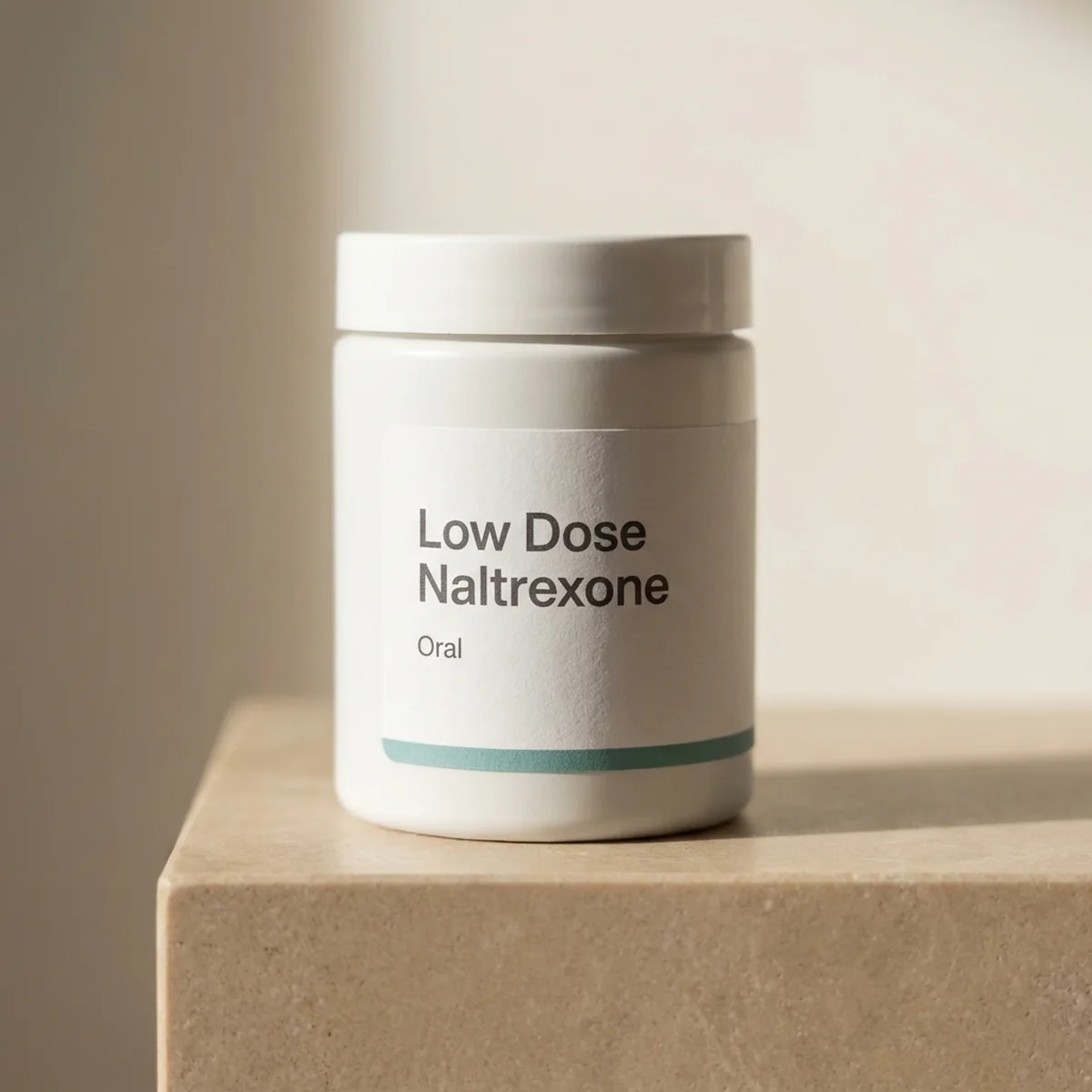
Compounded low-dose naltrexone, an off-label use, after a licensed provider's review. A licensed 503A compounding pharmacy prepares your order and ships it free.
From $128/mo with the 12-month plan and auto-refill
How would you like to pay?
Choose your plan
Prescription treatment requires an online medical evaluation. A provider decides whether treatment is appropriate; approval is not guaranteed.
Product details
Your plan
A licensed provider reads your health intake, decides if low-dose naltrexone is right for you and chooses the dose.
Compounded low-dose naltrexone, prepared by a licensed compounding pharmacy after approval.
Delivered to your door at no added cost.
Pay once, or turn on auto-refill and take 10% off. Change or cancel refills anytime.
A printable decision pack and a plain checklist for reading a study.
Help with your order and delivery when you need it.
How it works
Pick 1, 3, 6 or 12 months. Auto-refill takes 10% off each plan.
Answer a private online questionnaire. A licensed provider reviews it and chooses the dose.
If prescribed, the pharmacy prepares your order and ships it to you free.
Why people choose it
Each card links to the original study, with a tag for the kind of evidence behind it.
The FDA-approved naltrexone hydrochloride 50 mg tablet label states the tablets are indicated in the treatment of alcohol dependence and for the blockade of the effects of exogenously administered opioids.
Read the study Approved labelThe label for the 50 mg tablets states that any attempt by a patient to overcome the antagonism by taking opioids is especially dangerous and may lead to life-threatening opioid intoxication or fatal overdose.
Read the study Controlled human trialA randomised, double-blind, placebo-controlled trial of 6 mg low-dose naltrexone in 99 women with fibromyalgia concluded that the study did not show treatment with low-dose naltrexone was superior to placebo in relieving pain.
Read the study Controlled human trialA 12-week randomized trial of 4.5-mg naltrexone in forty adults with active Crohn's disease reports that 88% of naltrexone-treated patients had at least a 70-point decline in CDAI scores compared to 40% on placebo (p = 0.009). Two of its authors disclose a patent for the use of naltrexone in IBD.
Read the studyThe honest version
Trials were mostly small, and several placebo-controlled trials reported no benefit over placebo. Here is what the sources say, including company ties.
See every study we trackA randomised, double-blind, placebo-controlled trial of 6 mg low-dose naltrexone in 99 women with fibromyalgia concluded that the study did not show treatment with low-dose naltrexone was superior to placebo in relieving pain.
SourceA 12-month randomised, double-blind, placebo-controlled trial of LDN 4.5 mg/day in 98 women with fibromyalgia concluded that LDN was well tolerated but did not demonstrate a clinically meaningful benefit over placebo for pain-related outcomes.
SourceA systematic review and meta-analysis of five randomized controlled trials reports that low-dose naltrexone was superior to placebo in alleviating fibromyalgia pain in its primary analysis (SMD -0.61; 95% CI -1.14, -0.08) but not in raising mechanical pain threshold.
SourceA 12-week randomized, double-blind, placebo-controlled trial of 4.5-mg naltrexone in forty adults with active Crohn's disease reports that 88% of naltrexone-treated patients had at least a 70-point decline in CDAI scores compared to 40% of placebo-treated patients (p = 0.009). Its conflict-of-interest statement discloses that two of its authors have intellectual property rights and have a patent for the use of naltrexone in IBD.
SourceA Cochrane review on low dose naltrexone for Crohn's disease concludes that currently there is insufficient evidence to allow any firm conclusions regarding the efficacy and safety of LDN used to treat patients with active Crohn's disease.
SourceA narrative review of 105 low-dose naltrexone studies says early positive findings from uncontrolled studies were rarely replicated in placebo-controlled trials and most available evidence consists of case reports and small feasibility studies. It says LDN is generally safe, inexpensive and well tolerated, with most studies using a daily dose of 4.5 mg, but that current evidence does not support routine clinical use.
SourceThe FDA says compounded drugs are not FDA approved, which means the agency does not review their safety, effectiveness or quality before they are marketed.
SourceFAQ
The things people ask most before starting Low-dose naltrexone.
Compounded low-dose naltrexone, an off-label use of naltrexone, after a licensed provider's review. Your provider chooses the dose. A licensed 503A compounding pharmacy prepares your order and ships it free.
Low-dose naltrexone paid once: $179 for 1 month, $483 for 3 months, $913 for 6 months or $1,718 for 12 months. With auto-refill each is 10% off: $161, $434, $821 and $1,546 ($128.83 a month on the 12-month plan). Shipping is free, and the exact total is shown before you pay.
Yes. You complete an online health intake and a licensed provider decides whether low-dose naltrexone is right for you and chooses the dose. Choosing a plan does not guarantee a prescription.
The FDA-approved naltrexone product is the 50 mg tablet. Its label says the tablets are indicated in the treatment of alcohol dependence and for the blockade of the effects of exogenously administered opioids, and Drugs@FDA lists Revia (naltrexone hydrochloride 50 mg tablets) with an original approval date of 11/20/1984. Low-dose naltrexone is an off-label use: an FDA patient page says that if a patient and provider decide to use an approved drug for an unapproved use, FDA has not determined that the drug is safe and effective for the unapproved use. The product sold here is also compounded, and FDA says compounded drugs are not FDA-approved, meaning FDA does not verify their safety, effectiveness or quality before they are marketed.
A review abstract says it is hypothesized that lower than standard doses of naltrexone inhibit cellular proliferation of T and B cells and block Toll-like receptor 4, resulting in an analgesic and antiinflammatory effect. Another review abstract on neuropathic pain says the TLR4-microglial rationale is plausible but that measured plasma concentrations at 4.5 mg/day fall several orders of magnitude below those associated with TLR4 inhibition in vitro.
The sources are mixed, and most studies are small. In fibromyalgia, a single-blind pilot crossover trial in ten women and a randomized crossover trial of 4.5 mg daily in thirty-one women reported symptom or pain reductions with low-dose naltrexone. A randomised trial of 6 mg in 99 women, a crossover study of 4.5 mg once daily in fifty-eight patients and a 12-month trial of 4.5 mg/day in 98 women each reported no superior or clinically meaningful benefit over placebo on pain, and a meta-analysis of five randomized trials reported LDN superior to placebo on fibromyalgia pain in its primary analysis. In Crohn's disease, a 12-week randomized trial of 4.5 mg in forty adults reported 88% of naltrexone-treated patients with at least a 70-point decline in CDAI scores versus 40% on placebo, and two of its authors disclose a patent for the use of naltrexone in IBD; a Cochrane review concluded there is insufficient evidence for firm conclusions. A narrative review of 105 studies says early positive findings from uncontrolled studies were rarely replicated in placebo-controlled trials.
A 2025 meta-analysis of randomized controlled trials in chronic pain syndromes (dose not stated in the abstract) reported that adverse events were increased with LDN compared to placebo. In observational chart reviews, which cannot show cause and effect, 32% (13 of 41) of Veterans reported adverse effects including vivid dreams, drowsiness, dizziness, and nausea, and adverse effects occurred in 49.5% of patients in one physician's practice, most frequently nausea and fatigue, with no serious adverse effects reported. The adverse-reaction percentages on the 50 mg tablet label come from trials in alcohol and opioid dependence and are not rates for low-dose naltrexone.
The sources used here do not say what applies at low doses. For the 50 mg tablet, the label says patients taking naltrexone hydrochloride may not benefit from opioid containing medicines, such as cough and cold preparations, antidiarrheal preparations, and opioid analgesics, and tells prescribers to advise patients to be off all opioids, including opioid-containing medicines, for a minimum of 7 to 10 days before starting in order to avoid precipitation of opioid withdrawal. It states that patients may be more sensitive to opioids, even at lower doses, after treatment is discontinued, and that cases of opioid overdose with fatal outcomes have been reported after discontinuing treatment. The information for patients section of the label tells prescribers to advise all patients, including those with alcohol dependence, to notify healthcare providers of any recent use of opioids or any history of opioid dependence before starting naltrexone hydrochloride.
The 50 mg tablet label says cases of hepatitis and clinically significant liver dysfunction were observed in association with naltrexone hydrochloride exposure, and that studies employing up to five-fold higher doses (up to 300 mg per day) than that recommended for opiate receptor blockade have shown that naltrexone hydrochloride causes hepatocellular injury in a substantial proportion of patients exposed at higher doses. It states that depression, suicide, attempted suicide and suicidal ideation have been reported in the postmarketing experience in the treatment of opioid dependence, and that no causal relationship has been demonstrated. If you or someone you know is struggling or having thoughts of suicide, the National Institute of Mental Health says you can call or text the 988 Suicide & Crisis Lifeline at 988.
The pregnancy section of the 50 mg tablet label states that there are no adequate and well-controlled studies in pregnant women and that naltrexone hydrochloride should be used during pregnancy only if the potential benefit justifies the potential risk to the fetus, and that naltrexone has been shown to increase the incidence of early fetal loss when given to rats. It says whether it is excreted in human milk is unknown and that caution should be exercised when it is administered to a nursing woman. The information for patients section of the label says to advise patients to notify their physician if they become pregnant or intend to become pregnant during treatment with naltrexone hydrochloride or are breast-feeding.
The FDA says section 503A of the FD&C Act describes the conditions under which compounded human drug products are exempt from the FD&C Act sections on FDA approval prior to marketing, current good manufacturing practice (CGMP) requirements, and labeling with adequate directions for use. One of the section 503A conditions is that the drugs must be compounded based on the receipt of valid patient-specific prescriptions. FDA also says consumers who purchase compounded drugs online, such as through online pharmacies and telehealth platforms, may not know the identity of the compounder that produced the drug, and that compounded drugs are not FDA-approved.
No. You can pay once for 1, 3, 6 or 12 months, or turn on auto-refill and take 10% off. You can change or cancel refills anytime.